Why you need breached password detection
Criminals are always seeking opportunities to gain unauthorized access to
organizational systems. As such, user accounts are a prime target in any
organization.
Even though many companies have implemented passwordless authentication
nowadays, passwords are still a common way to authenticate user accounts. While
establishing a secure password etiquette would be a good solution, encouraging
users to adopt best practices has proven to be unreliable.
Password breach detection is a clever and strategic solution to prevent leaked
credentials from being used.
The risks of using leaked passwords
Leaked passwords are not an abstract or theoretical risk.
Recent data breaches have
affected major companies like T-Mobile, Optus, IKEA, Apple, Meta, TikTok, and
Twitter, each compromising millions of user accounts.
The
IBM Security Cost of a Data Breach Report
reveals that the average total cost of a data breach globally in 2023 was $4.35
million. In the United States, the average total cost of a data breach in 2023
is significantly higher at $9.44M million. It takes an average of 9 months to
identify and contain a data breach.
Compromised passwords from breaches can lead to fraudulent transactions and
account takeovers, resulting in businesses facing substantial customer service
and chargeback costs.
A recent study
predicts that fraudulent online transactions will cost merchants $206 billion
between 2021 and 2025.
Additionally, breaches provide fertile ground for hackers, who trade passwords
to take over a multitude of other accounts, for services such as email, banking,
e-commerce, payments, and others.
How you can prevent poor password practices
Users often have poor password habits and previous attempts to solve this
problem through increasingly complex password policies have not been successful.
In fact they often led to users seeking to meet minimal requirements rather than
creating secure passwords.
Due to the often confusing and contradictory password policies, remembering
multiple passwords with different requirements is difficult for users, leading
them to reuse passwords despite the risks.
Studies
have shown 85% of users reuse the same passwords for multiple if not all
personal and work accounts.
Modern password-breaking software makes use of a vast collection of leaked
passwords to break into accounts. This is why it is important to check if a
password has been leaked before allowing a user to use it.
NIST recommendations for breached password detection
The National Institute of Standards and Technology (NIST)
recommends breached password
detection systems that verify user-provided passwords against collections of
previous breaches and dictionaries.
If a user's password is found to be compromised, NIST suggests forcing the user
to select a different password while providing an explanation for the rejection.
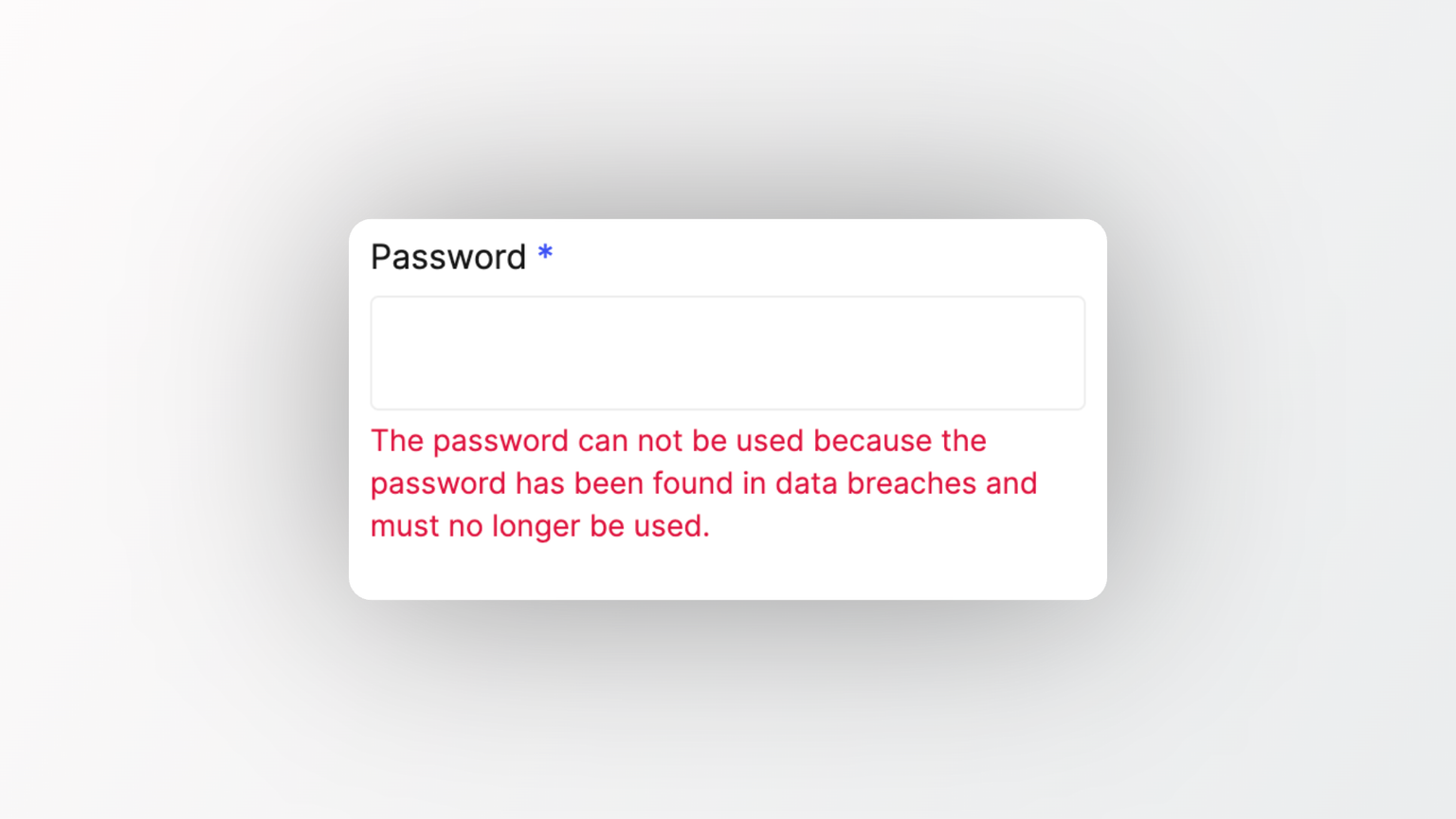
It is important to let users know why their password was rejected, not only to
inform users about compromised accounts. But also to not cause frustration and
confusion as to why their favourite password is not accepted.
Read about password policy best practices in the
Ory documentation to get an
overview of NIST recommendations on how to design a secure and usable password
policy.
Effective solutions for tackling password breaches in a modern cloud environment
Traditional password hygiene practices place the full responsibility to take
proactive measures on the user, whereas breached password detection provides an
automated solution to prevent the use of compromised passwords.
Some organizations choose to create their own data ingestion system and breached
password detection API, allowing for custom dictionaries and greater control
over the system's design. However, this approach requires significant resources
and expertise to develop and maintain.Unless your use case requires it, Ory
recommends to make use of third-party APIs that provide reliable and easy-to-use
solutions to implement breached password detection.
Breached password detection ♡ multifactor authentication
By employing breached password detection at the signup stage, organizations can
proactively prevent compromised credentials from entering the system.
However, doing periodic checks for breached passwords holds little security
advantage. The instant criminal actors gain access to a leaked password, they
exploit it and look to escalate their access. They will not wait around for the
periodic check to catch the leak. A periodic check for leaked passwords will
help only in the rare edge case that the check is done in the small time frame
between the password getting leaked and the bad actor getting access to the
leaked password.
How do we stop bad actors when passwords for existing accounts are leaked?
The answer is
multi-factor authentication. If
the account's password is compromised the attacker will not be able to access it
if a second factor has been added. This powerful combination effectively
safeguards against the exploitation of leaked or breached passwords and holds a
good balance between usability and security.
Protect your users and business from password threats
Humans are messy and unpredictable, and they often make mistakes.
This is why organizations require automated threat detection and incident
response management for effective security. Breached password protection
automates the identification of breached password risks to ensure application
security and protect customers.
All passwords entering Ory Network are checked by default against a vast
collection of almost 1 billion leaked passwords by the industry leading
haveibeenpwned.
As always with Ory this feature is
open source, as are all other security
relevant features.
Breached password detection for enhanced security today
In summary:
- Adopting a breached password detection solution is an effective approach to
address the issue of breached passwords without relying on changes in user
behavior.
- Implementing breached password detection reduces the risk of unauthorized
account access by preventing the use of compromised passwords.
- Breached password detection protects applications and systems by preventing
any leaked password from entering the system.
- Ory provides protection against common
threats, offers
comprehensive documentation,
support, and 24/7 assistance.