Usage-based billing
Overview
Usage-based invoices are a feature in the Ory Console that allows you to understand your usage of Ory Network services, the usage that is included in your plan, and the overuse. Usage-based invoices are generated every month. For the current billing period, a draft invoice is generated every six hours.
Usage-based invoices only apply to workspaces and projects contained therein, but not to legacy plans that have individual subscriptions.
Ory Console UI
Usage invoices are only available for workspaces on a paid subscription plan. The usage will always be invoiced monthly, even if the plan is paid annually. For the current billing period, the usage is generated as a preview and refreshed at most every six hours. The final invoice is generated at the end of the billing period.
Depending on the plan, the service usage is comprised of at least three components:
- the average daily active users (aDAU),
- the number of machine-to-machine (M2M) tokens issued, and
- the number of permission checks.
Additionally, your invoice might include extra charges for additional multi-tenant production environments, etc. For more information of what's included in your plan visit our pricing page.
Usage credits will be applied to the total service usage, but unused credits will not be carried over to the next billing period.
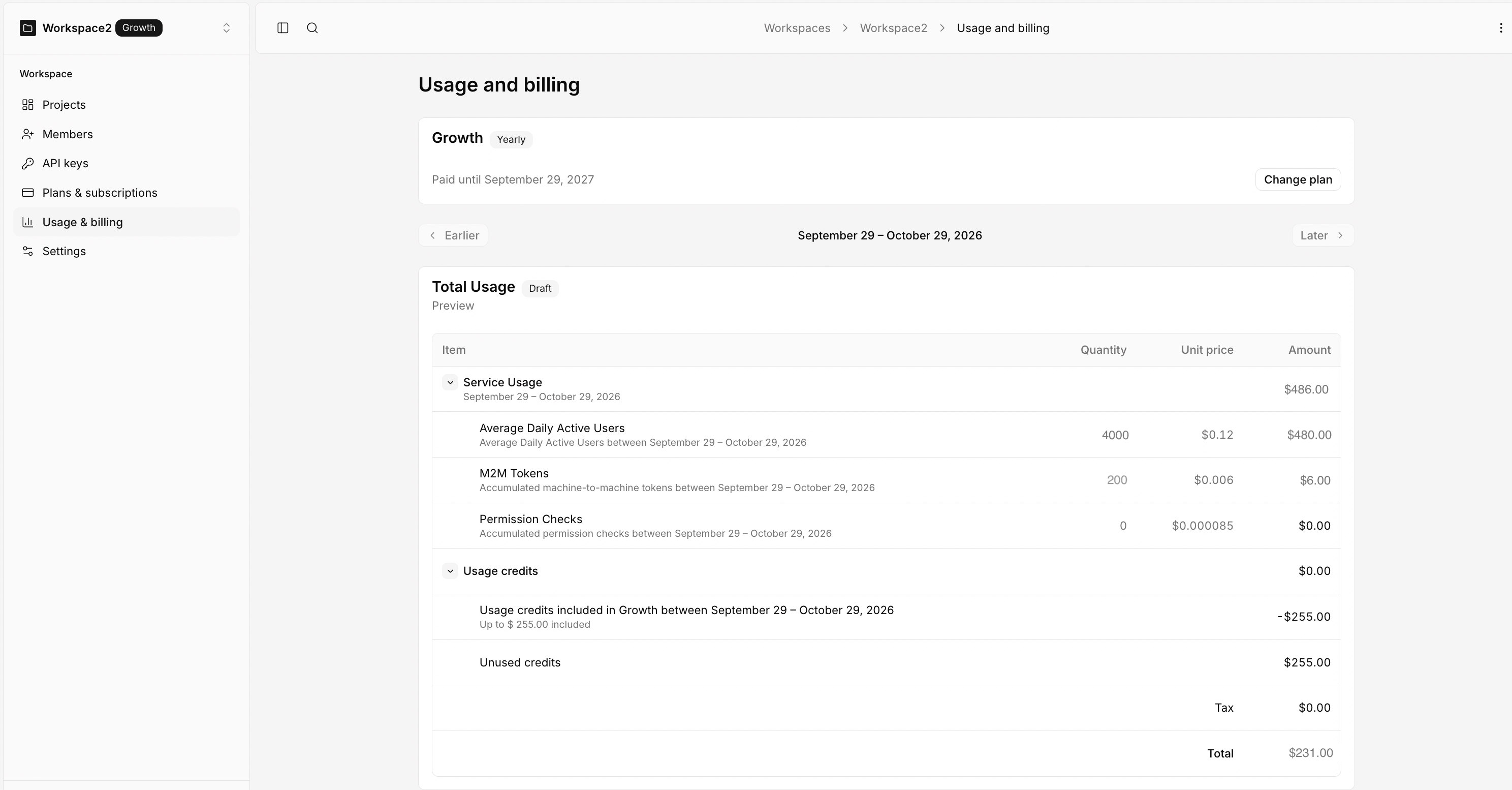
Billing periods and cost breakdown
Use Earlier and Later to move between billing periods. Each period shows one invoice card for every invoice in that period, including the usage invoice and any base plan invoices.
Every invoice lists its line items in a table with Item, Quantity, Unit price, and Amount columns. Expand a line item to see its nested breakdown, for example the cost per component that makes up a usage charge.
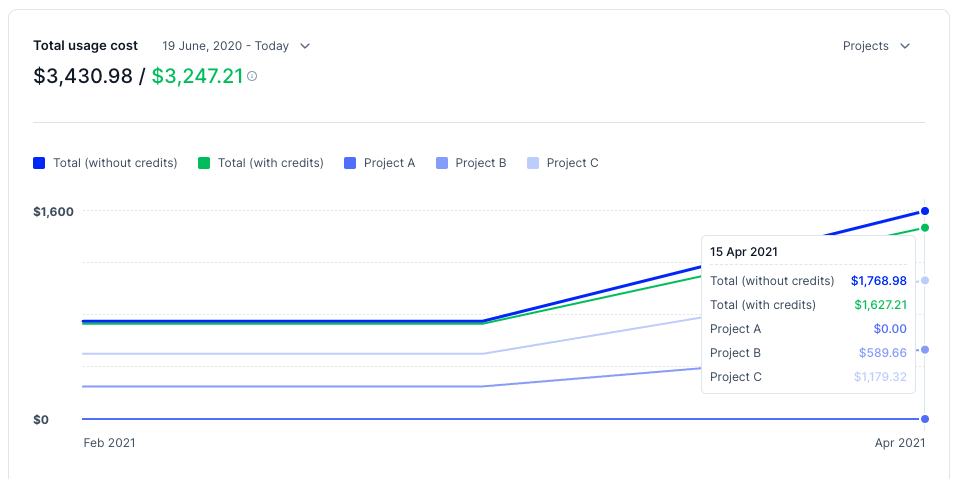
Invoices for the current billing period
The invoice for the current billing period is a preview of the costs. While M2M token issuance and permission checks are billed per usage (accumulative), the aDAU usage is calculated as the average of the last 30 days. This means that the aDAU usage for the current billing period can increase or decrease until the end of the billing period.
Proration, upgrades and downgrades
Upgrades and downgrades of the base plan affect the usage-based billing in both the usage credits as well as the per-unit price.
Downgrades always become effective at the end of the billing period, and will therefore not be reflected on the current usage invoice.
Upgrades are effective immediately and will be prorated. Specifically for usage credits, this means that the usage credits will be factored by the relation of time on that plan to the total time span of the billing period. As an example, if you upgrade from plan A to plan B after ⅔ of the billing period, you will receive ⅔ of the usage credits of plan A and ⅓ of the usage credits of plan B.