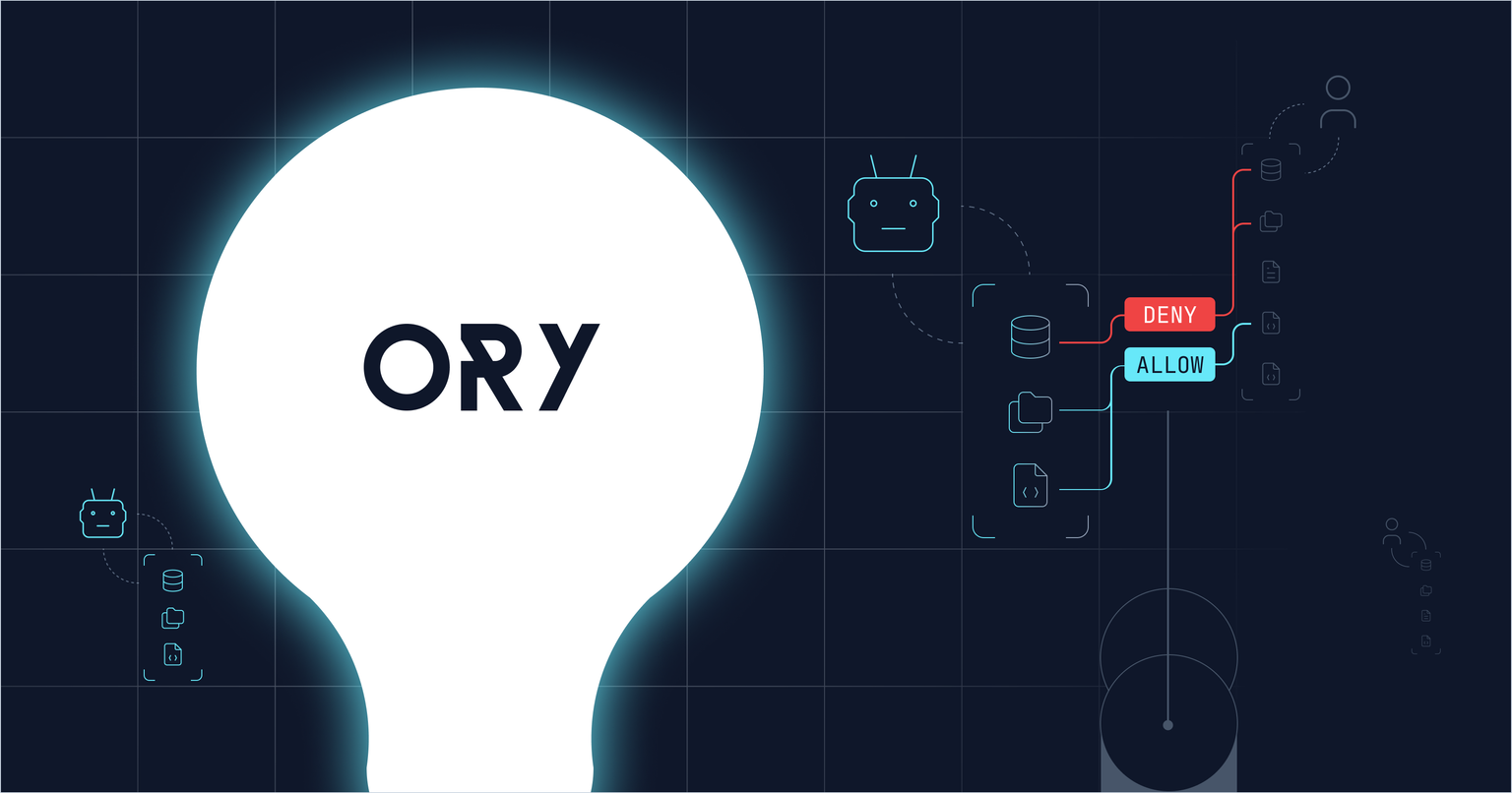
The rise of AI agents—autonomous pieces of software that can plan, reason, and act on their own—is rapidly transforming the enterprise. They are managing supply chains, executing financial trades, and drafting complex legal documents without direct human intervention. But as these digital entities gain unprecedented freedom, a profound question emerges: Who, or what, is doing the work?
Adrian Bridgwater, writing for Forbes, recently posed a critical question that encapsulates this challenge: Should AI agents carry identity cards? Ory and our CEO, Jeff Kukowski are featured prominently.
While we won't be printing wallet-sized badges for our algorithms, the underlying technical answer is an unequivocal yes. For AI to move from experimental tool to trusted enterprise partner, it must be governed, and that governance starts with a verifiable, traceable, and secure digital identity.
The Accountability Crisis: When an Agent Fails, Who Gets the Blame?
In the business world, accountability is non-negotiable. This principle is codified in our security infrastructure through Identity and Access Management (IAM) systems. IAM ensures we know who did what, where, and when. When a human employee logs in, their identity is confirmed, their permissions are enforced, and every action is logged for auditing.
But AI agents complicate the picture:
- If an agent autonomously modifies a database, misprices an order, or executes an erroneous trade, how do you trace the root cause?
- How do you ensure an agent is operating with the principle of least privilege, only accessing the data and systems it absolutely needs?
- How can you prove to a regulator that an autonomous action complied with internal policy?
Without a unique, verifiable identity for the agent, the answer to all these questions is: You can't. The action becomes a security and auditing black hole.
The Case for Digital Personhood
Security vendors in the IAM space are increasingly advocating for treating machines—and specifically AI agents—as entities that require digital “personhood” for governance. This isn't a philosophical statement about consciousness; it’s a pragmatic necessity for security and compliance.
Just as a piece of hardware is tracked with an inventory tag, and a software package is documented with a Software Bill of Materials (SBOM) to ensure transparency of its components, an AI agent needs a persistent identity that ties its actions back to its origin.
This digital ID is crucial for three primary reasons:
- Auditing and Compliance: An identity allows enterprises to link every autonomous action to a specific, identifiable agent, proving adherence to regulatory and internal policies.
- Security and Trust: By assigning an identity, security teams can restrict the agent’s permissions based on its purpose. This prevents a generalized agent from having access to sensitive systems it was never designed to interact with, minimizing the security surface area.
- Governance: The identity provides a necessary tether to the human or department that created, deployed, and maintains the agent, restoring the human-level accountability lost to autonomy.
The Next Frontier for IT Governance
Managing this new class of digital identity presents a significant challenge. We are not just dealing with a few hundred developers; we could soon be managing millions of non-human, digital identities across an enterprise.
An AI agent's identity must be more robust than a simple username. It must be traceable, verifiable, and tied to:
- The creator and sponsor of the agent.
- The purpose and scope of its operations.
- Its specific version and the data model it is running on.
The age of the invisible, untracked AI worker is drawing to a close. For organizations to scale their AI adoption safely and confidently, the creation of a sophisticated and secure digital identity layer for AI agents isn't optional—it's the mandatory foundation for the autonomous enterprise.
Continue reading about Agentic AI and Ory: