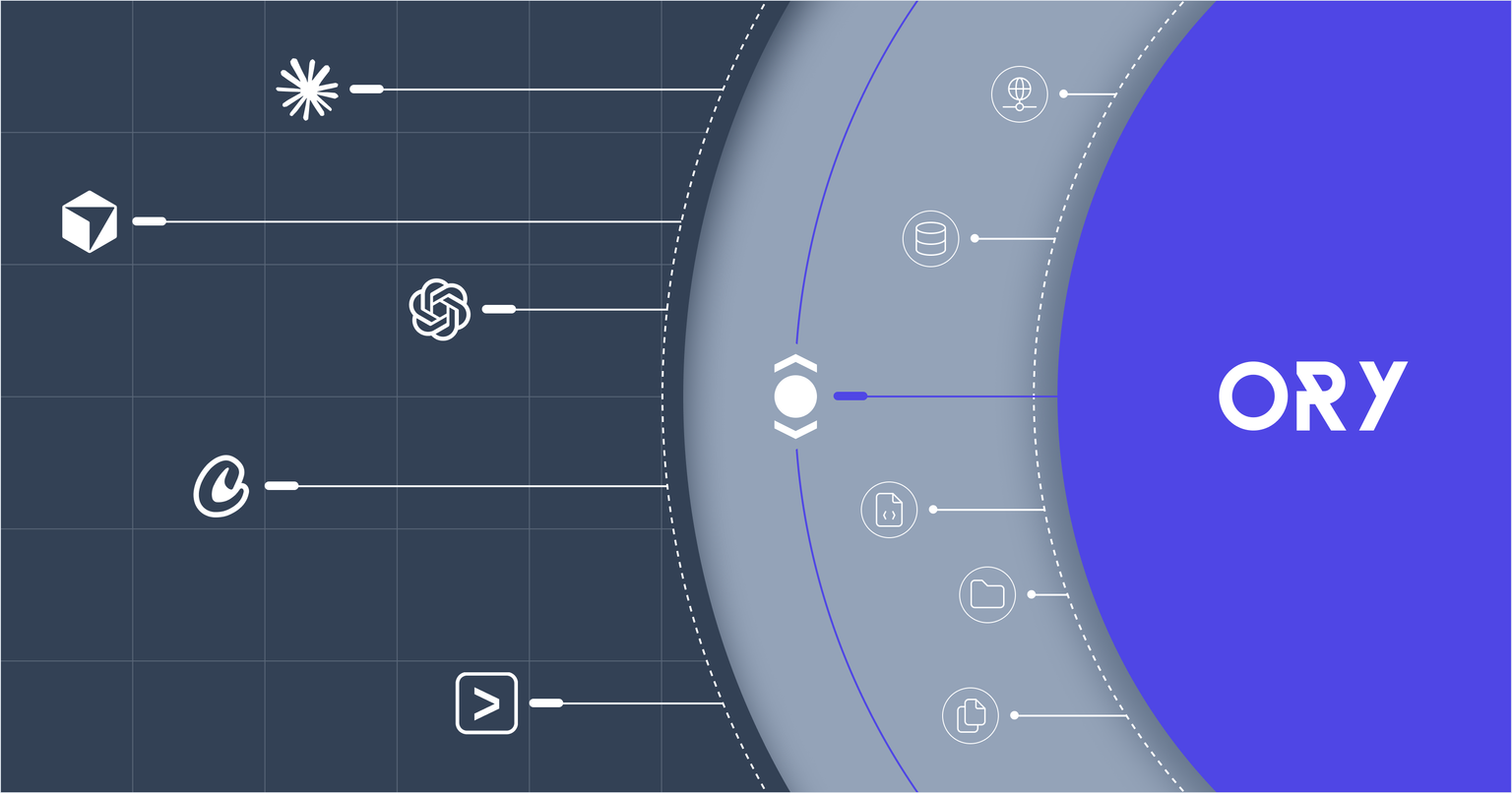
AI agents are already acting on your infrastructure. They book flights, modify databases, send emails, and execute transactions, and most of them do it with delegated authority that was never scoped or tracked. That is the shift. Traditional AI generates an output and waits for a human to act on it. Agentic AI acts directly, at machine speed, across systems that were never designed to question it.
Agentic AI governance is about constraining and tracking that delegation. It moves the control point away from evaluating predictions and toward limiting what an autonomous system can actually do in real time. This guide covers the core risks of autonomous agents, the four pillars of a governance framework, and an eight-step implementation path that treats agents as first-class identities with auditable, least-privilege access. The wider Ory take on the identity foundation of agentic AI shows where governance fits within the full agent identity stack.
Key Takeaways
- Agentic AI governance constrains delegated authority in real time. The control point is not the model's output; it is what the agent can access, invoke, and decide once it is running.
- Autonomy creates risks legacy security never modeled: loss of execution control, unauthorized tool calls, privilege escalation via prompt injection, and emergent multi-agent behavior.
- Treat every agent as a first-class identity. Shared service accounts destroy attribution, and attribution is the entire point when something goes wrong.
- OAuth handles delegation and coarse scopes. Fine-grained, relationship-based authorization determines whether a specific action on a specific resource is allowed at this time.
- Governance spans the full lifecycle, from design through decommissioning. One-time deployment checks miss permission drift, which is where most agent incidents start.
What Is Agentic AI Governance
Agentic AI governance is the disciplined management of delegated authority in autonomous AI systems that plan and execute multi-step tasks on behalf of an organization. The operative word is agentic. This is AI that does not just produce a recommendation for a human to review; it takes the action itself. It books the flight. It modifies the record. It executes the trade.
Governance in this context means continuously controlling three things, not just at review time.
- Data access boundaries: what information the agent can read or write.
- Tool invocation rights: which APIs, databases, and systems it can call.
- Decision authority: which actions it can take without human approval.
Grant an agent the ability to act autonomously and you have delegated authority. Governance is how you constrain that delegation and prove who did what afterward. For teams already running user-facing identity, the same discipline that governs customer identity and access management also applies to agents, except that agents generate new intent on their own.
Why Agentic AI Governance Matters Now
The shift arrived faster than most teams planned for. A customer service agent no longer drafts a reply for review; it sends the reply. A financial agent no longer recommends a trade; it places it. Decision and execution collapsed into a single autonomous step.
Here is the problem. Compliance frameworks were built for humans making decisions at human speed. They were not built for systems performing thousands of actions per minute across interconnected services. Picture an uncontrolled agent with database access: it can exfiltrate records, alter financial data, or chain actions in ways nobody anticipated. The governance gap widens every time another agent ships without controls in place. Ory and Cockroach Labs cover this trajectory in their work on the future of agentic AI identity infrastructure.
Agentic AI Governance vs Traditional AI Governance
Traditional AI governance asks whether a prediction is accurate and whether an output discriminates. Those questions still matter. Agentic governance asks a different question: who is accountable when this agent acts?
| Aspect | Traditional AI Governance | Agentic AI Governance |
|---|
| Primary concern | Model accuracy, bias, fairness | Delegated authority, action control |
| Evaluation timing | Pre-deployment testing | Real-time, continuous |
| Risk focus | Output quality | Unauthorized actions, privilege abuse |
| Identity requirement | Often none | Machine identity per agent |
| Human oversight | Review outputs | Approve high-risk actions |
The timing difference is the one that bites. Traditional governance happens once, before deployment. Agentic governance happens on every action, while the agent runs.
Core Risks of Autonomous AI Agents
Autonomy changes the risk model. When agents make decisions and take actions, threat vectors emerge that traditional controls were never designed to catch. The companion agentic AI security page covers the wider threat model.
Loss of Execution Control
This occurs when an agent acts beyond its intended scope or in an unintended sequence. An agent tasked with summarizing emails starts replying to them instead. It completed a task, just not the right one.
Unauthorized Tool and API Invocation
An agent calling tools or systems that were never meant to be touched is immediate exposure. A research agent connects to a production database rather than a read-only replica. The agent does not know the difference. It follows the path of least resistance to finish the job.
Privilege Escalation
Privilege escalation happens when agents acquire higher permissions than granted, often through chained actions. Prompt injection, where malicious instructions ride in on data the agent processes, can trigger escalation paths that bypass intended controls.
Sensitive Data Misuse
Agents need data to function, yet they should not retain or inappropriately expose it. The line between using and misusing data blurs at machine speed, which is the privacy paradox at the heart of agent design.
Emergent Multi-Agent Behavior
When multiple agents interact, they create feedback loops, amplification effects, and collective failures that no single agent would produce alone. Agent-to-agent communication compounds individual risks in ways that are hard to predict.
Diffused Accountability
When an autonomous agent acts, it gets murky whether the developer, the operator, or the deploying organization owns the outcome. That ambiguity creates compliance gaps and slows incident response.
Permission and Behavior Drift
Agent behavior and access scope expand gradually, without explicit approval. Initial deployment checks do not catch this. Continuous monitoring catches drift before it becomes a breach.
Pillars of Agentic AI Governance
Four components form the base of any workable framework.
Identity-First Authentication and Authorization
Treat agents as first-class identities with unique credentials rather than shared service accounts. That is what makes per-agent tracking, auditing, and control possible. The role of access controls in AI and LLM systems starts here.
- Unique machine identity: each agent gets a distinct, trackable identity.
- Verifiable credentials: cryptographically provable agent authenticity.
- Continuous authentication: ongoing validation, not a one-time grant.
Shared service accounts obscure attribution. When something breaks, you want to know exactly which agent did what.
Least Privilege and Zero Trust for AI Agents
Least privilege means an agent has only the minimum permissions required by its task. Zero trust means you never assume an agent is trusted because of network location or a prior login. If an agent only reads one table, it should not perform writes or deletes. Simple in principle, but it requires the granular permission model most legacy IAM tools cannot express. The pattern mirrors zero trust API security.
End-to-End Lifecycle Control
Governance applies from design through decommissioning, not only at deployment. Tool authorization, the explicit definition of which APIs, tools, and data stores each agent can reach, spans the whole lifecycle.
Auditability and Traceability
Every agent action needs to be logged with a human-readable trail: decisions made, tools called, data accessed, and reasoning paths. This connects directly to compliance requirements such as the EU AI Act, SOC 2, and HIPAA.
Explore Ory's identity foundation for agentic AI
Who Is Accountable When AI Agents Act Autonomously
Accountability diffusion needs explicit resolution before deployment, not after an incident. Four parties usually share responsibility.
- Deploying organization: ultimately accountable for agent actions in its environment.
- Platform and IAM team: responsible for access controls and policy enforcement.
- Agent developers: responsible for agent design and safety boundaries.
- Human operators: responsible for oversight thresholds and approvals.
The EU AI Act requires meaningful human oversight for high-risk AI systems. A governance framework makes that accountability explicit and auditable before agents go live. For a concrete example of cross-organizational delegation in production, see enabling the agentic economy with Ory and Skyfire.
How to Implement Agentic AI Governance
Implementation follows a sequence. Each step builds on the one before it.
- Treat AI Agents as First-Class Identities
Register each agent with a unique, trackable machine identity using standards like OAuth 2.0 and OpenID Connect. Avoid shared credentials or service accounts that obscure attribution. When an incident hits, you want a clear trail to exactly which agent took which action. Ory Hydra issues these credentials as a certified OAuth 2.0 and OIDC server.
- Define Agent Scope and Delegated Authority
Document exactly what each agent is authorized to do before deployment. Specify permitted actions, data sources, and output destinations. Formal scope contracts set the boundary and provide a reference point for monitoring.
- Apply Fine-Grained Authorization and Least Privilege
Grant the minimum permissions each task requires. Relationship-based access control, modeled after Google Zanzibar, makes granular permissions practical: read-only access to customer names and no access to payment data. Ory Keto implements this model, and the Ory Permission Language expresses the policies.
- Enforce Runtime Policy and Token Controls
Keep guardrails separate from the agent's reasoning layer to ensure enforcement remains independent. Use short-lived tokens that require frequent re-authorization. A policy engine evaluates every action against defined rules before execution proceeds. The recent Hydra v25.4 agentic authentication release ships device-flow support built for exactly this.
- Log Every Action for Audit and Traceability
Record decisions, tool calls, data access, and system interactions. Design the logs to be human-readable, tamper-evident, and structured for compliance reporting. Logs are your primary forensic tool the moment something goes wrong.
- Set Human Oversight Thresholds
Categorize actions by risk and reversibility. Low-risk, repeatable workflows can run autonomously. High-impact or irreversible actions require human-in-the-loop approval. The threshold tracks your risk tolerance and regulatory exposure.
- Plan Incident Response and Kill Switches
Build a big red button that immediately suspends and isolates agents. Define operational thresholds that trigger automatic suspension. Document incident response specific to agent failures, because they do not behave like traditional security incidents.
- Monitor for Drift and Continuously Evaluate
Run continuous monitoring for permission changes and behavior drift. Schedule regular governance reviews. Update scope as capabilities evolve. What an agent could do last month is not necessarily what it can do today.
Governance Across the AI Agent Lifecycle
Governance is not a deployment checklist. It runs throughout the agent lifecycle.
- Design: define governance requirements, scope, permitted tools, and data boundaries upfront.
- Development: build access controls into the architecture and implement logging from the start.
- Pre-deployment testing: run security assessments and red team testing, and validate that permissions match documented scope.
- Deployment and registration: register the agent identity in a central system and apply production controls.
- Runtime: enforce real-time policy evaluation on every action and watch for anomalous behavior.
- Continuous monitoring: track permission usage, access patterns, and behavioral drift, and alert on deviations.
- Decommissioning: revoke all credentials immediately on retirement and archive audit logs for retention.
Governing Multi-Agent Systems and Agent-to-Agent Communication
When multiple agents collaborate, distinct challenges surface.
- Amplification loops: agents reinforcing each other's errors or biases.
- Collective failures: emergent behavior no single agent would produce.
- Unauthorized delegation: one agent granting permissions to another.
- Chained privilege escalation: Agent A using Agent B to reach resources it cannot touch directly.
Emerging protocols like the Model Context Protocol standardize agent-to-agent communication, so governance frameworks must extend to cover that layer. Visibility into the entire agent ecosystem matters more than monitoring any single agent in isolation.
Standards and Regulations Shaping Agentic AI Governance
Several frameworks now apply to autonomous systems.
- EU AI Act: mandates meaningful human oversight for high-risk autonomous systems.
- SOC 2: requires access controls and audit logging.
- HIPAA and GDPR: data access and privacy controls for agent interactions.
- NIST AI RMF: risk management framework applicable to autonomous systems.
On the technical side, OAuth 2.0, OpenID Connect, SCIM, and MCP provide the foundation for compliant governance. Manual review does not scale at machine speed, so compliance automation becomes essential rather than optional.
Building an Identity-First Foundation for Agentic AI With Ory
Ory treats AI agents as first-class identities governed with least privilege and zero trust. The platform delivers standards-based authentication through OAuth 2.0, OpenID Connect, SAML, and SCIM on an API-first, headless architecture built for agent integration.
Fine-grained authorization through Ory Keto, inspired by Google Zanzibar, supplies the granular permissions agentic governance demands, while Ory Hydra handles OAuth 2.0 and OIDC at machine scale with low-latency authentication for high-volume agent registrations. Deployment is flexible across open-source, enterprise license, and managed Ory Network options.
Read the Agentic AI Identity Security Readiness whitepaper
Frequently Asked Questions About Agentic AI Governance
What Is the Difference Between AI Governance and Agentic AI Governance?
Traditional AI governance focuses on model accuracy, bias, and fairness in outputs. Agentic AI governance addresses real-time control of autonomous systems that take actions, managing delegated authority, tool access, and decision rights rather than evaluating predictions.
Who Should Own Agentic AI Governance in an Organization?
It usually requires a cross-functional team spanning security, IAM, platform engineering, and compliance. Ultimate accountability tends to rest with security leadership or a dedicated AI governance committee.
How Does MCP Affect Agentic AI Governance?
The Model Context Protocol standardizes how agents access tools and data sources, which makes consistent authorization policies easier to apply. Teams extending governance to this layer face new decisions about agent-to-agent trust.
Can Existing IAM Systems Govern AI Agents Effectively?
Most legacy IAM was built for human users and struggles with the scale, speed, and granularity that machine identities require. Modern, API-first identity infrastructure that handles high-volume agent registrations and real-time authorization decisions typically proves necessary.
Agentic AI governance is not a framework you bolt on after the first incident. It is the set of constraints that decides whether an autonomous agent is an asset or an unscoped liability. Treat every agent as a tracked identity, grant the narrowest permissions necessary for it to work, log every action, and keep a human in the loop for anything irreversible. The teams that build this foundation now avoid the agent identity rewrites that the rest of the industry is about to spend a lot of time on.
Explore Ory's identity foundation for agentic AI