AI agents are making API calls on behalf of your users right now, and most of them are doing it using static API keys that never expire and permissions that were never properly scoped.
As enterprises race to deploy autonomous AI systems, engineering and security teams face a familiar crossroads: how do we authorize these non-human identities (NHIs) without completely re-engineering our security architecture?
The easiest path, and the one most teams are taking, is to issue traditional API keys. But while API keys are the bedrock of modern software integration, treating an autonomous AI agent like a standard script introduces massive, unprecedented security risks.
Here is why API keys are the default choice, why they break down when applied to AI agents, and how Ory Talos introduces a web-scale, security-hardened approach to solve the agentic identity crisis.
Why It Matters: The Gravity of Familiarity
When developers need to connect an AI agent to an internal database, a CRM, or a payment gateway, they inevitably reach for an API key. This preference isn't accidental; it’s driven by several structural realities:
- Known Tech & Universal Familiarity: Every software engineer knows how to generate, pass, and authenticate an API key. There is no learning curve or protocol friction.
- Existing Systems Are Already In Place: Your API gateways, reverse proxies, and microservices are already configured to intercept, parse, and validate API key strings.
- Low Integration Friction: For fast-moving AI engineering teams, pasting a string into an environment variable takes 10 seconds. Setting up complex OAuth 2.0 authorization code flows for a headless, background AI worker feels like over-engineering.
Using API keys makes sense for prototyping. But when that agent moves to production and begins generating its own intent, traditional API keys rapidly transition from a convenience to a critical liability.
The Core Challenge: Why Traditional API Keys Fail AI Agents
We made this exact mistake with service accounts a decade ago. We issued permanent, high-privilege credentials to backend scripts, only to spend years dealing with leaked keys and compromised environments.
AI agents accelerate this vulnerability exponentially because they do not follow fixed, predictable scripts. They reason, plan, and adapt dynamically. When you secure a highly autonomous system with a standard API key, you run into three critical problems:
1. The Threat of Unlimited Lifetimes
Traditional API keys are static and long-lived. If an AI agent logs its execution context during an error state and accidentally dumps its environment variables into an external monitoring tool, that key is compromised indefinitely until a human manually rotates it.
2. Over-Permissioning and the "Blast Radius"
Because it's difficult to predict exactly which tools or endpoints an LLM-driven agent might decide it needs to accomplish a goal, developers routinely over-permission keys. If an agent has a key with broad write access, a single successful prompt injection attack can trick the agent into weaponizing its own credential, deleting tables, exfiltrating data, or executing unauthorized transactions at machine speed.
3. Distribution, Leaks, and Hardcoding
As agents multiply and spawn sub-agents dynamically, managing the distribution of static secrets becomes impossible. Keys get hardcoded into agent codebases, embedded in custom marketplace tools, or inadvertently pushed to public repositories. Once distributed, knowing where a key lives, and who is actively using it, becomes an operational black box.
Introducing Ory Talos: Hardening the Secret Surface
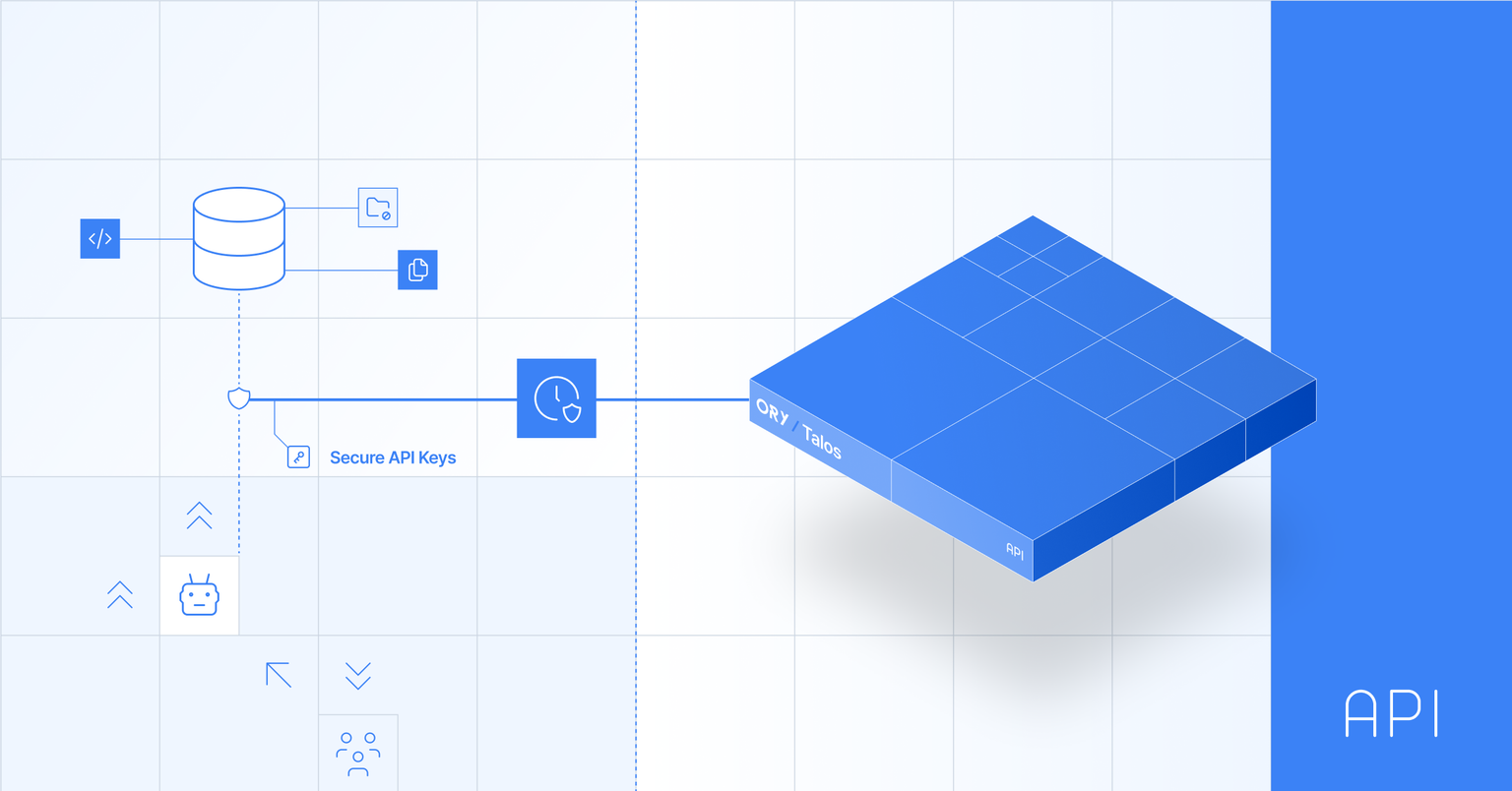
Ory Talos is a web-scale, security-hardened API key security solution purpose-built for users, services, machine-to-machine (M2M) interactions, and autonomous AI agents. It bridges the gap between the simplicity of API keys and the zero-trust requirements of enterprise security.
Ory Talos directly neutralizes the structural flaws of traditional credentials through a series of innovations:
Token Derivation and Dynamic Secrets
Instead of forcing an AI agent to carry a long-lived parent API key into runtime environments, Ory Talos enables token derivation. A secure backend exchanges the parent key on-demand for a short-lived child token. If a child token is intercepted or leaked by an agent, it naturally expires in seconds or minutes. Best of all, invalidating the parent credential at the Ory Talos layer instantly kills every downstream child token across the entire network.
Macaroon-Based Chained Delegation
AI workflows frequently rely on hierarchical architectures, where a primary agent delegates sub-tasks to specialized sub-agents. Ory Talos leverages Macaroon-based delegation, allowing keys to be dynamically wrapped with cryptographic caveats as tasks move down the chain.
For instance, a primary agent with a broad "access billing" credential can narrow that permission to "execute payments under $50.00 for the next 2 minutes" before passing it to a subordinate worker. Cryptographically, these permissions can only narrow, never expand, ensuring strict least-privilege compliance at runtime.
IP Whitelists and Time-to-Live (TTL)
Ory Talos enforces zero-trust boundaries by allowing you to attach strict IP Whitelists and Time-to-Live (TTL) expirations directly to your API credentials. By binding tokens to specific server IPs, any credential leaked or weaponized through a prompt injection attack becomes instantly useless outside your designated network.
Simultaneously, configuring short-lived TTLs ensures that even if a child token is compromised within an authorized network, its utility automatically expires in minutes, drastically minimizing the blast radius and preventing long-term exploitation.
Token Prefixes for Rapid Scanning
Ory Talos attaches short, human-readable strings to the front of generated API keys (e.g., ory_ak_...). This makes credentials instantly recognizable to automated secret scanners, allowing security teams to flag and revoke leaked keys in public repositories before they can be exploited.
Beyond AI: Universal Machine-to-Machine Benefits
While Ory Talos is an ideal fit for the complex, unpredictable nature of agentic AI governance, its architecture delivers massive benefits to standard enterprise infrastructure:
- High-Throughput Machine-to-Machine (M2M) Security: Traditional API key validation bottlenecks databases because every incoming request requires a synchronous lookup. Ory Talos balances this by minting derived tokens that can be verified offline via cryptographic signatures without hitting a central database on every hot-path request.
- Decoupled Architecture: It functions as a standalone, low-latency service written in Go. You do not need to adopt the broader Ory ecosystem (Ory Hydra, Ory Kratos, Ory Keto) to use Ory Talos; it slots directly into your existing API gateway and microservice topology.
How to Get Started with Ory Talos
Ory builds on the philosophy of open source transparency with clear pathways for teams scaling from local prototypes to global production. You can deploy Ory Talos in three ways:
1. Ory Open Source (OSS)
The open-source edition of Ory Talos is licensed under Apache 2.0 and runs as a single instance backed by an embedded SQLite database. It is perfectly tailored for developers, researchers, and teams prototyping local agentic architectures without complex operational overhead.
2. Ory Enterprise License (OEL)
For business-critical environments where API key verification lives on the application's hot path, the Ory Enterprise License unlocks advanced multi-node capabilities. This includes native support for high-availability databases (PostgreSQL, MySQL, CockroachDB), distributed caching, multi-tenancy, rate-limiting, and dedicated enterprise SLAs for security patches and CVEs.
- Get Started: Contact us and inquire about OEL licensing
3. Ory Network
The fastest path to production is the Ory Network, which delivers the capabilities of Ory Talos as a fully managed, globally distributed SaaS platform. It eliminates infrastructure management entirely, automatically scaling your agentic and M2M identity controls across a global edge with built-in compliance and zero operational maintenance.
The Bottom Line
You don't have to abandon the simplicity of API keys to secure your AI agents. By deploying Ory Talos, you give your developers the familiar workflows they want, while giving your security teams the dynamic, short-lived, and revocable control that enterprise zero-trust demands.