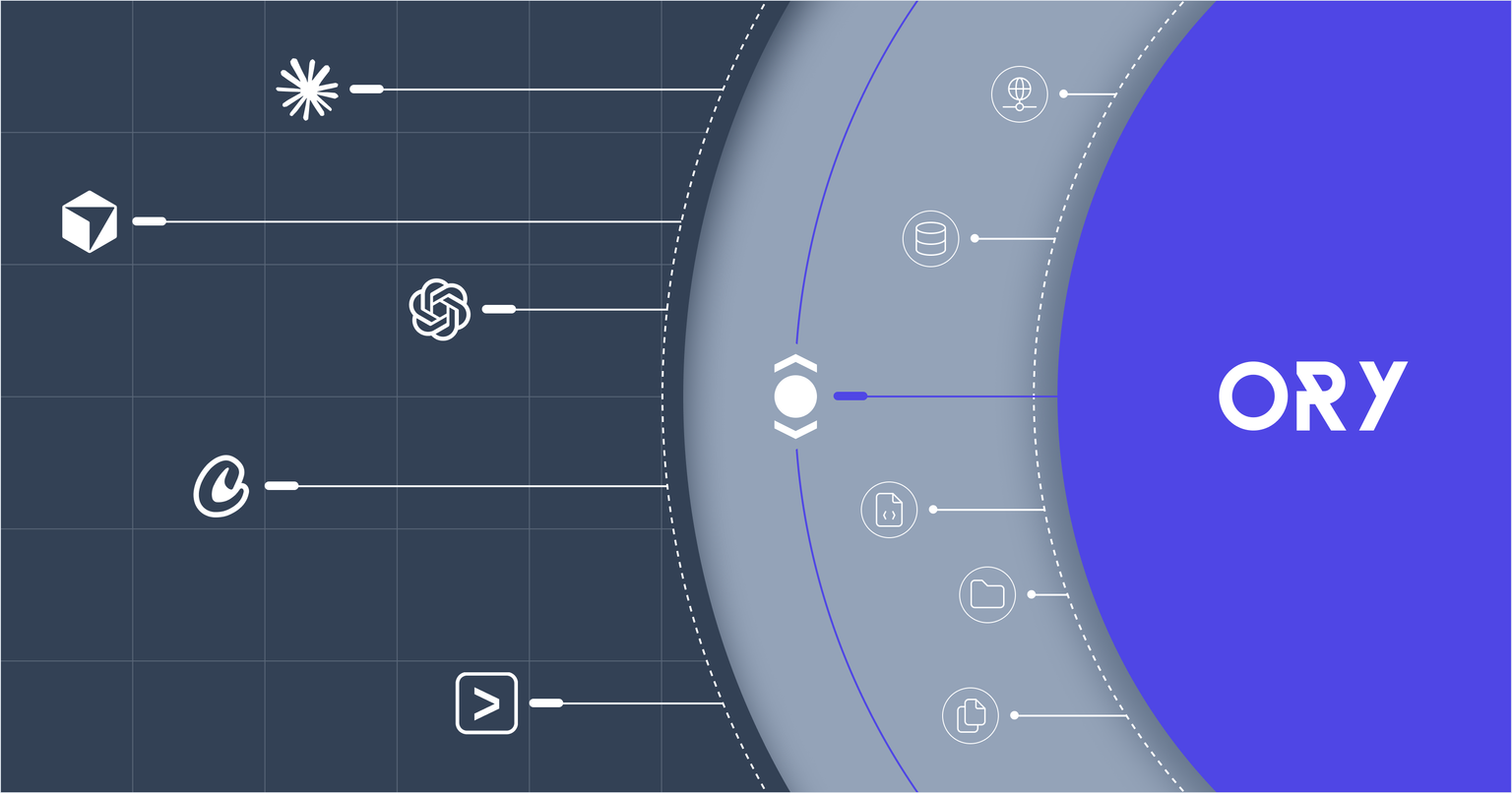
Most enterprises can’t go all-in on cloud identity. They also can’t stay locked into legacy directories forever. Hybrid IAM is the architecture that emerges from that reality: keep sensitive identity data in your own data center, and use cloud IAM for modern authentication, scale, and global reach. You get custody where it matters and elasticity where it counts.
This guide covers how hybrid IAM differs from pure on-prem and cloud approaches, the components that make it work, why enterprises are moving this way, and how to evaluate vendors without getting locked in. For the wider context on where this sits in the identity stack, Ory’s customer identity and access management hub frames the full picture, and the breakdown of CIAM versus traditional IAM is worth a read first if those terms blur together for you.
Key Takeaways
- Hybrid IAM keeps your authoritative identity directory on-prem while running authentication, SSO, and modern flows from the cloud. You don’t have to choose custody or scale. You get both.
- The model exists because real enterprises run mixed environments: legacy apps coupled to Active Directory, customer apps in AWS or Azure. Hybrid IAM bridges them without a big-bang migration.
- Data residency, compliance, and immovable legacy systems are the three drivers that push teams to hybrid. None of them are going away.
- Synchronization is where hybrid deployments break. Orphaned accounts and stale permissions are the predictable failure mode when directory sync isn’t solid.
- Open standards (OAuth 2.0, OIDC, SAML, SCIM) and modular components are what keep hybrid IAM from becoming a new flavor of vendor lock-in.
What Is Hybrid IAM?
Hybrid IAM is an identity and access management architecture that combines on-premises identity infrastructure with cloud IAM services. In practice, you keep your core identity directory, where credentials and sensitive data live, inside your own data center. Then you tap cloud IAM for modern authentication, elastic scale, and global reach.
The reason this model exists is simple: most organizations no longer operate in a single environment. You might have legacy applications tightly coupled to Active Directory on-prem while your customer-facing apps run in AWS or Azure. Hybrid IAM bridges that gap without forcing a full migration to either side. If you’re weighing this against a pure cloud move, the field notes on modern CIAM migration cover what that transition actually looks like.
Hybrid IAM vs. On-Premises IAM vs. Cloud IAM
To see where hybrid fits, compare the three approaches side by side.
| Aspect | On-Premises IAM | Cloud IAM | Hybrid IAM |
|---|
| Identity data location | Your data center | Provider’s cloud | Split across both |
| Deployment model | Self-managed infrastructure | SaaS or managed service | Combined |
| Scalability | Limited by hardware | Elastic, on-demand | Flexible per workload |
| Compliance control | Full custody | Shared responsibility | Granular control |
| Typical use case | Regulated legacy systems | Cloud-native apps | Mixed environments |
On-Premises IAM
On-premises IAM runs your identity infrastructure entirely inside your own data centers. Directories, authentication servers, and access policies all live on hardware you control. You get complete custody over where data resides and how it’s protected. The cost is that scaling means hardware investment and operational burden land on your team.
Cloud IAM
Cloud IAM delivers identity services as SaaS from a third-party provider. Deployment is fast, scaling is automatic, and you offload infrastructure management. The trade-off: you’re trusting a vendor with identity data, which complicates compliance, and vendor lock-in becomes a real concern when your authentication flows depend on proprietary APIs.
Hybrid IAM
Hybrid IAM takes the middle path. You retain control of core identity directories on-prem, often Active Directory or LDAP, while running authentication, SSO, and modern flows from the cloud. This has become increasingly common as enterprises operate across multiple environments at once. The same split logic shows up in global, multi-region identity deployments, where data must stay local but auth must work everywhere.
Core Components of a Hybrid IAM Architecture
A working hybrid deployment needs specific building blocks that operate across environments. Here’s what typically makes up the stack.
Identity Directory and User Store
The identity directory is your authoritative source of user records, the single source of truth for who exists in your organization. In hybrid setups, this usually means Active Directory or LDAP on-prem, synchronized to a cloud identity provider via SCIM (System for Cross-domain Identity Management). SCIM handles automatic creation, update, and deletion of accounts across systems. For the mechanics, see this primer on SCIM and directory sync.
Authentication Services and SSO
Single sign-on lets users authenticate once and reach multiple applications without re-entering credentials. Hybrid IAM uses federated protocols to enable login across on-prem apps and cloud services:
- SAML (Security Assertion Markup Language): An XML-based protocol common in enterprise SSO.
- OIDC (OpenID Connect): A modern protocol built on OAuth 2.0, widely used for web and mobile.
The user experience stays consistent no matter where the application lives. If you’re deciding between protocols, the guide on when to use OAuth 2.0 and OpenID Connect lays out the decision, and the breakdown of SAML SSO from the user side fills in the enterprise half.
Multi-Factor and Passwordless Authentication
Multi-factor authentication adds verification beyond passwords. The factors fall into three buckets: something you have (a phone or hardware key), something you are (biometrics), or something you know (a PIN). Hybrid IAM layers these across both environments.
Passwordless options like passkeys and WebAuthn remove passwords entirely, cutting both friction and the risk of credential theft. WebAuthn is a W3C standard for authenticating with biometrics or hardware keys.
Authorization and Access Policies
Authorization determines what a user can do once they’ve proven their identity. Common models:
- RBAC (Role-Based Access Control): Permissions tied to job roles like “admin” or “viewer.”
- ABAC (Attribute-Based Access Control): Permissions based on attributes and context, such as department or location.
- ReBAC (Relationship-Based Access Control): Permissions derived from relationships between entities, like “owner of document X.”
In a hybrid model, these policies span on-prem and cloud resources, which is exactly the problem a Zanzibar-style engine was built to solve. The evolution of Ory Keto from Google Zanzibar explains why relationship-based authorization scales across environments where RBAC alone stalls.
Identity-Aware Proxy and Zero Trust Enforcement
An identity-aware proxy is a gateway that validates identity and context before granting access to any resource. In Zero Trust architectures, no implicit trust exists. Every request gets evaluated, whether it originates inside or outside the network perimeter. The proxy enforces continuous verification instead of treating network location as a trust signal.
Federation, SCIM, and Directory Sync
Federation establishes trust among identity providers, allowing users from one system to access resources in another without creating duplicate accounts. SCIM automates provisioning and deprovisioning to keep directories synchronized. Without proper sync, you get orphaned accounts—records that stay active after someone leaves or changes roles. Orphaned accounts are a real security risk because they’re standing entry points for attackers. For the trade-offs between approaches, compare SSO versus identity federation and the broader case for identity federation.
Stolen credentials appear in 39% of all analyzed breaches overall, remaining a primary method for initial access, privilege escalation, and lateral movement - 2026 Verizon DBIR
Why Enterprises Are Adopting Hybrid IAM
Several pressures push organizations toward hybrid. Understanding the drivers tells you whether it fits your situation.
Data Residency and Sovereignty Requirements
Regulations like GDPR require identity data to stay within specific geographic boundaries. A company serving European customers may be legally required to store identity data in the EU. Hybrid IAM allows on-prem storage in compliant locations while still using cloud IAM for authentication and access management.
Regulatory and Compliance Pressure
HIPAA, PCI-DSS, and SOC 2 mandate strict identity controls and audit trails. Hybrid IAM helps you meet those requirements while modernizing. Compliance and cloud adoption don’t have to be mutually exclusive.
Legacy Systems That Cannot Move to the Cloud
Many enterprises have critical applications tightly coupled to on-prem directories. A 20-year-old ERP integrated with Active Directory isn’t moving to the cloud anytime soon. Hybrid IAM bridges these systems to modern authentication without ripping out existing infrastructure.
Cloud Migration and Multi-Region Operations
Teams moving workloads to the cloud need identity to span both environments during and after migration. Hybrid IAM supports phased transitions rather than high-risk, big-bang cutovers. You move applications incrementally while identity management stays consistent.
Avoiding Vendor Lock-In
Open-source and modular hybrid approaches let you avoid dependency on a single cloud vendor’s identity stack. When authentication uses open standards like OAuth 2.0 and OIDC, switching providers becomes feasible rather than a full rebuild. This is the practical argument behind choosing an open-source Auth0 alternative.
Explore Ory’s hybrid deployment options
Key Benefits of Hybrid IAM
What do organizations actually gain?
- Stronger security posture: Keeping sensitive credentials on-prem limits exposure, while cloud IAM adds adaptive threat detection. Defense in depth across both environments.
- Operational control over identity data: Security teams keep direct custody of records, which matters for audits and incident response.
- Frictionless user experience: SSO and passwordless flows mean no multiple logins or inconsistent authentication across environments.
- Lower total cost of ownership: A hybrid approach leverages existing on-prem investments while incrementally adding cloud capabilities.
- Faster time to value: Cloud IAM components deploy fast for new applications without waiting on on-prem changes.
Common Challenges of Hybrid IAM Deployments
Hybrid IAM isn’t free of complexity. Being honest about the hard parts helps you plan.
Identity Sprawl Across Directories
When identities reside in multiple disconnected directories, management overhead increases and security gaps emerge. One user might hold three accounts with inconsistent permissions across systems.
Synchronization and Replication Complexity
Keeping on-prem and cloud stores consistent in real time is technically demanding, especially at scale. Sync failures lock users out or, worse, leave access active after it has been revoked.
Policy Consistency Across On-Prem and Cloud
Enforcing authorization rules uniformly across both environments when apps span them requires careful design. A permission granted in one system may not translate correctly to another, creating gaps or conflicts.
Operational Overhead and Skills Gaps
Hybrid IAM needs teams fluent in both traditional directory services and modern cloud IAM. That combination is scarce, and people who genuinely understand both worlds are hard to hire.
Hybrid IAM Use Cases Across Identity Contexts
Hybrid IAM applies across different identity populations, not just employees.
Customer Identity and Access Management
Customer-facing apps often need cloud-scale and passwordless UX, but identity data may need to stay on-prem for privacy reasons. Modular CIAM platforms support this split by separating user management from authentication services. Ory Kratos handles identities and login flows, which is the piece you most often want close to your own data.
B2B Partner and Supplier Access
External partners usually need self-service onboarding with strict permission boundaries tied to real business relationships. Hybrid IAM lets you federate with partner identity providers while precisely controlling what partners can access. When accounts come in from multiple providers, secure account linking across SSO, OIDC, and SAML is the pattern that keeps it clean.
Workforce Identity and Access
Employee access often spans legacy HR systems on-prem and cloud productivity tools like Microsoft 365 or Google Workspace. SSO across both cuts friction and support tickets, and it removes the password-reset load that quietly eats helpdesk time.
Machine and Agentic AI Identity
Machine identity covers credentials for applications, services, and AI agents. As agentic AI systems call APIs at scale, hybrid IAM must secure these machine-to-machine interactions with the same rigor applied to human interactions. API keys, service accounts, and OAuth client credentials all fall under this category, and the MCP server authentication pattern with Ory Hydra shows how to do it without static, never-expiring keys.
When to Choose Hybrid IAM
Hybrid IAM makes sense in several scenarios:
- Regulated industries with strict data controls: Finance, healthcare, and government often face requirements that make pure cloud IAM difficult.
- Enterprises modernizing legacy CIAM: Teams moving from monolithic solutions toward modular, open architectures benefit from hybrid flexibility.
- Multi-region and global customer bases: Companies serving customers across geographies need an identity that performs consistently while meeting local compliance requirements.
- Organizations implementing Zero Trust: Zero Trust needs identity-aware enforcement at every layer, which hybrid IAM supports across on-prem and cloud.
How to Implement Hybrid IAM
A practical implementation follows a sequence:
- Inventory identity stores and applications. Audit every directory, identity provider, and application. You can’t secure what you don’t know exists, and most teams find shadow IT in this step.
- Define authentication and authorization requirements. Document which methods and policies each application and user population needs. Different apps carry different risk profiles.
- Select modular, API-first components. Choose components that integrate via open standards: OAuth 2.0, OIDC, SAML, SCIM. API-first design lets you customize without vendor constraints.
- Establish directory sync and federation. Configure sync between on-prem directories and cloud IAM, plus federation trust between providers. Test sync hard before going live.
- Roll out SSO, MFA, and passwordless flows. Deploy modern authentication progressively, starting with highest-risk or highest-value applications.
- Monitor, audit, and iterate. Implement logging to track access events and detect anomalies. Identity systems generate security telemetry that can be fed into your wider operations.
How to Evaluate Hybrid IAM Vendors
When selecting a platform, several criteria matter:
- Deployment flexibility: Does the vendor support open source, enterprise self-hosted, and fully managed SaaS options?
- Open standards support: Is the platform built on OAuth 2.0, OIDC, and SAML with transparent, auditable code?
- Scalability: Can it handle your user scale with multi-region replication and low-latency authentication?
- Compliance coverage: Does it support your regulatory frameworks and data residency regions?
- Developer experience: How is the documentation? Are there SDKs and a headless, API-first architecture for custom integration?
Run Hybrid IAM Your Way With Ory
Ory’s modular suite supports hybrid deployments across open source, enterprise self-hosted (OEL), and the fully managed Ory Network. Ory Kratos handles identities and authentication. Ory Hydra runs OAuth 2.0 and OpenID Connect. Ory Keto provides fine-grained, Zanzibar-style authorization. Ory Oathkeeper acts as the identity-aware proxy, Ory Talos provides ways to secure API keys, and Ory Polis covers enterprise SSO via SAML and OIDC.
The API-first, headless design integrates with existing infrastructure while avoiding vendor lock-in through open standards. You keep your authoritative directory where compliance requires it and run modern flows wherever you need them, on one composable stack rather than five disconnected tools.
See how Ory’s components fit into your hybrid stack
Frequently Asked Questions About Hybrid IAM
What Is a Hybrid Identity Administrator?
A hybrid identity administrator manages identity infrastructure spanning on-premises directories and cloud identity services. The role covers seamless authentication and consistent access policies across environments, directory synchronization, and troubleshooting federation issues.
What Does It Mean to Have a Hybrid Identity?
A hybrid identity is a single user account that exists and synchronizes across on-premises and cloud identity systems. Users authenticate seamlessly no matter where apps are hosted, and their permissions stay consistent across environments.
Is Hybrid IAM More Secure Than Cloud-Only IAM?
It can be, by keeping sensitive credentials on-prem while using cloud IAM for adaptive threat detection. But security ultimately depends on proper configuration and policy enforcement across both environments. A poorly configured hybrid setup can introduce more risk than a well-managed cloud-only one.
How Does Hybrid IAM Support Zero Trust Security?
Hybrid IAM supports Zero Trust by requiring continuous identity verification at every access point. Identity-aware proxies and contextual policies apply whether resources are on-prem or in the cloud, eliminating implicit trust based on network location.
Can Hybrid IAM Be Built on Open-Source Components?
Yes. Hybrid architectures can use open-source components like Ory Kratos for user management, Ory Hydra for OAuth 2.0 and OIDC, and Ory Keto for fine-grained authorization. Open-source foundations provide transparency and help avoid vendor lock-in.
How Does Hybrid IAM Handle Data Residency Requirements?
Hybrid IAM addresses residency by storing identity data on-premises or in specific regions while still using cloud IAM for authentication and access management. The directory stays where regulations require it, while authentication services run globally.
Hybrid isn’t a compromise you settle for. It’s the architecture that matches how enterprises actually run: regulated data in your custody, modern authentication in the cloud, and a single consistent identity layer across both. Get the directory placement right, make sync bulletproof, and build on open standards so you’re never rebuilding from scratch when the next migration comes. The teams that treat hybrid as a deliberate design, not a halfway state, are the ones who stop fighting their identity stack and start shipping on it. For where this fits in the full picture, the customer identity and access management hub is the place to start.